
A Quiet Act of Kindness at EverBank Stadium That Spoke Louder Than Any Celebration
The roar inside EverBank Stadium still echoed long after the final whistle. Buffalo Bills fans were celebrating a historic victory over the Jacksonville Jaguars, a hard-fought game that would be remembered for its drama, stakes, and playoff implications.
Yet, as confetti fluttered and cameras searched for emotional reactions, one of the night’s most powerful moments unfolded quietly on the sidelines—away from the spotlight, away from reporters, away from traditional post-game theatrics.
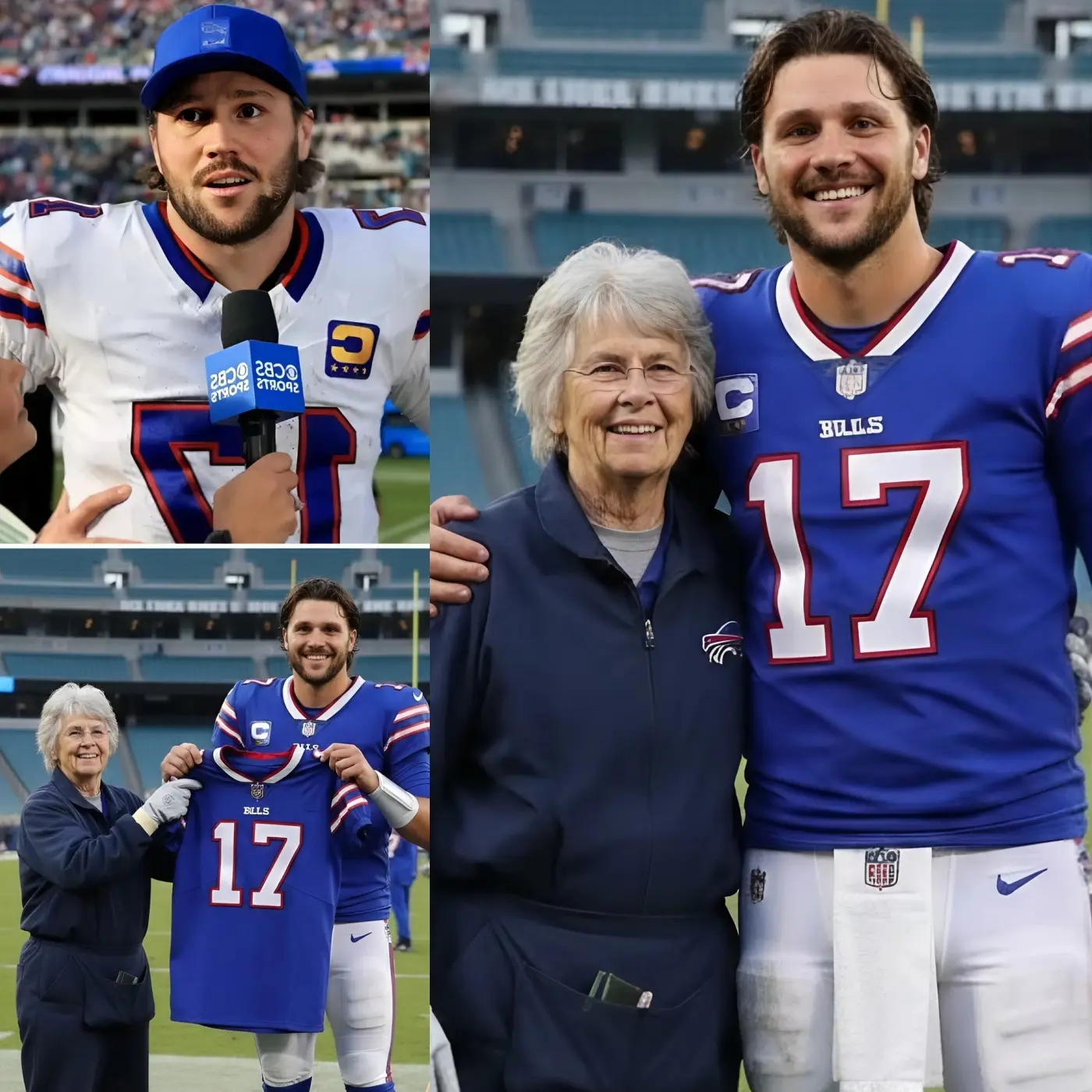
Instead of heading straight to the locker room or basking in the celebration with teammates, Bills quarterback Josh Allen walked toward the edge of the field. The scene contrasted sharply with the energy surrounding him.
While players embraced and fans cheered, an elderly stadium cleaner—estimated to be around 70 years old—methodically folded towels, gathered stray water bottles, and tidied equipment that had been left behind in the chaos of competition.
She was doing what she always does, unnoticed and uncelebrated.
Allen approached slowly, removed his helmet, and knelt down to her level. For a brief moment, the frenzy of the stadium seemed to fall silent. This was not a staged interaction, not part of a photo opportunity, and not something highlighted on the scoreboard.
It was simply one human being acknowledging another.
Witnesses said he spoke just one sentence to her. What he said has circulated widely online, paraphrased, quoted, and reflected upon, but the essence remains the same: he thanked her. Not just a casual “thanks”—but a sincere expression of appreciation for her work, contribution, and presence.
In a world where stadium workers often go unseen despite keeping sports venues functioning smoothly, Allen’s gesture carried a rare weight.

Those near enough to observe described the woman’s reaction as stunned at first, then deeply moved. She had likely watched players run past her for years, their focus fixed on the game, rarely on the people who clean up after it. In that moment, she was not background staff.
She was the center of someone’s full attention—someone millions of people recognize.
Social media quickly amplified the story once fans shared what they saw. But beyond viral headlines and emotional captions lies the real heart of the moment: respect. Allen didn’t have to do anything dramatic or elaborate. He didn’t give a speech to the crowd or call press attention to himself.
He simply paused and acknowledged a person whose work is essential yet almost always invisible.
Acts like these resonate because they remind people what sports at their best can represent. Yes, games are about competition, skill, and strategy. They are also about connection. Stadiums are filled with countless individuals—ushers, cleaners, groundskeepers, concession workers—who ensure that the spectacle unfolds smoothly.

Without them, the bright lights and big plays could not exist in the same way. Yet so many of them pass through their shifts without a single player learning their names or offering more than a nod in passing.
Allen’s gesture emphasized something often forgotten: a championship mindset does not only show itself on the field. Leadership includes humility, gratitude, and compassion. Kneeling down to thank a stadium cleaner after one of the biggest games of the year sent a message stronger than any post-game interview soundbite.
For the elderly worker, this brief exchange reportedly “changed her life,” according to those who later spoke about the encounter online. Not because fame suddenly followed her, but because someone acknowledged her work with sincerity. Recognition, especially when unexpected, can be transformative.
It reminds people that what they do matters, even when the world rarely pauses long enough to say so.
This moment also arrives at a time when conversations around dignity in labor are more visible than ever. Across industries, workers who maintain, clean, and support public spaces are increasingly finding their voices. Allen’s act did not solve systemic issues, nor was it meant to.
But it did shine a gentle light on the theme of respect. It suggested that appreciation does not have to come through grand gestures; sometimes it is as simple as speaking directly, kindly, and face-to-face.
Sports fans often measure greatness through statistics—touchdowns thrown, yards rushed, games won. Those numbers matter, but they don’t tell the full story of character. Role models are defined not only by athletic achievements but by the way they treat people who cannot advance their careers or improve their fame.
The cleaner could not help Allen secure endorsements or game-winning plays. Yet he valued her anyway.

The images and accounts of the moment quickly spread, moving fans around the world. Many commented that they were brought to tears not because of dramatic speeches or cinematic celebrations, but because of the simplicity of the exchange. In a setting built around spectacle, quiet humanity stood out.
As the stadium lights dimmed and celebrations continued, the elderly cleaner returned to her work—finishing the job she had started. But now she did so carrying the weight of unexpected appreciation. Allen eventually joined his teammates, but he did so having already made a different kind of mark that night.
In the end, the story from EverBank Stadium is about more than football. It is about the way small choices ripple outward. A kneel, a sentence, a moment of eye contact—these are gestures available to anyone, at any level of fame or status.
They remind us that kindness is not measured in scale, but in sincerity.
The Bills’ victory will fill highlight reels and record books. Analysts will debate play calls, momentum swings, and postseason implications.
Yet years from now, many may remember something else entirely: that after a monumental win, a star quarterback chose not to run toward the cameras, but toward the sidelines—to thank a woman quietly cleaning up after the game.
In a stadium built for noise, it was the quietest moment that spoke the loudest.